Product
The Ferrari Luce backlash misses the point
Forget the silhouette. The details are the real design.
Forget the car perspective
The Ferrari Luce arrived to a brutal reception. Critics called the exterior too tall, too smooth, too unlike the low, theatrical machines people expect from Maranello. A widely shared post compared it to a budget Nissan or Toyota. Even the market flinched: Ferrari shares fell 8.4% in Milan the day after the reveal.
That tension is real. A Ferrari is not judged like a kettle or a camera. The silhouette carries decades of expectation, and Luce deliberately breaks it.
But stop at the bodywork and you miss the more interesting object. Forget the car perspective for a minute. Look at what happens when somebody touches it.
The key gives the whole game away
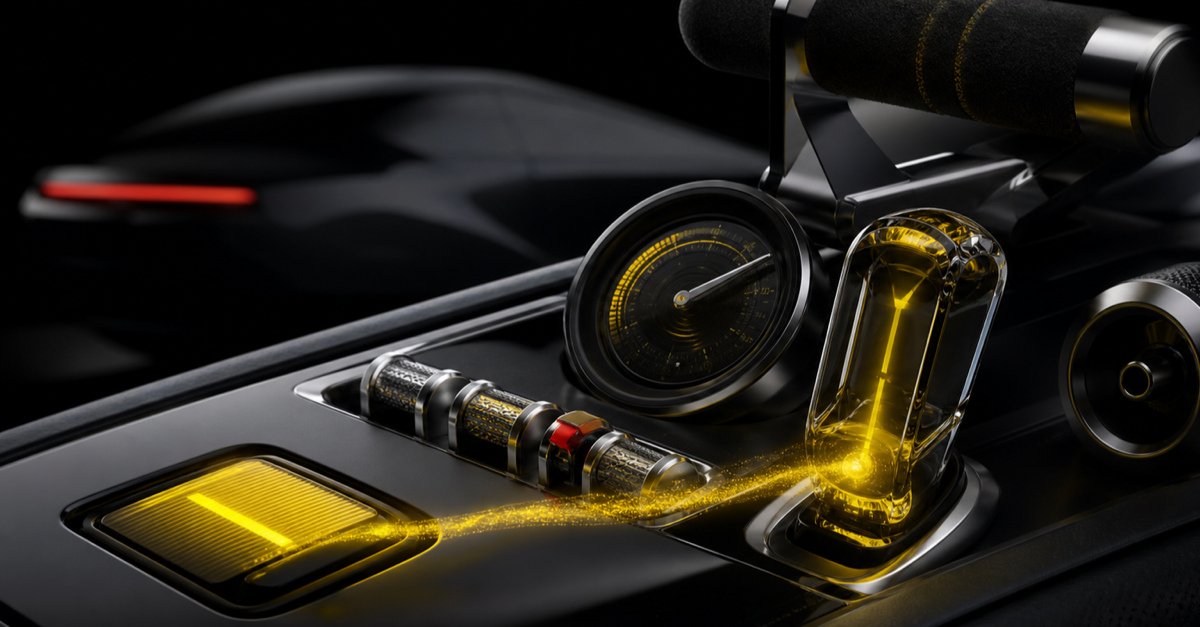
The key is a rectangle of glass with a bistable E‑Ink display: yellow in your hand, nearly black after a magnet guides it into the center console and it sinks flush with the surface.
At the same moment, the drive selector lights up. The yellow appears to leave the key and enter the car. Making that glow uniform required 13,000 laser-drilled holes, each 40 microns wide, behind the glass selector.
None of this is necessary to start an EV. That is precisely the point. A silent state change has been turned into a visible ritual, so “on” feels like an event rather than a status light.
Physical controls become the interface
The Luce keeps making that choice. Its main instruments layer two OLED displays, parabolic glass lenses, and a real physical speedometer needle. The center multigraph uses independent mechanical hands over changing digital graphics.
Climate functions sit on five aluminum toggles instead of disappearing into menus. The movable screen has a handle that doubles as a palm rest, so the hand can steady itself while the car moves. Knobs differ in shape, which lets touch carry information before the eyes arrive.
Quattroruote reports that the click, rotation, and pressure of the physical controls went through more than 20 evaluation tests with Ferrari drivers. That is mechanical feedback treated as interface design, not nostalgia.
Even launch control is staged
Then there is launch control. You do not tap a glowing rectangle. You reach overhead, pull down an aluminum handle, and twist it while the instrument graphics reorganize around the ritual.
Even the vents participate. Cylindrical aluminum outlets point where you aim them and open with a tuned mechanical click. The extensive aluminum is machined from billet; the glass is scratch-resistant Corning material shaped into controls, lenses, and surfaces rather than used as one giant screen.
Sound follows the same logic. Ferrari says a high-precision sensor captures the electric powertrain’s actual mechanical vibrations and amplifies them for direct feedback. It is not a fake recording of an engine. It is the machine revealing itself.
The product lesson is in the leftovers
LoveFrom described the cabin as roughly 500 individual design products. That framing explains why the Luce feels different: the seat rail, key, vent, toggle, needle, animation, and handle are each asked to earn attention.
This does not prove the exterior is beautiful, or even that Luce is the right Ferrari. It proves something narrower and more useful: coherence can be built from tiny moments, especially when a category’s old emotional cues disappear.
The Luce may remain a divisive Ferrari-shaped car. As a product object, it is a ruthless reminder that people can finish arguing about the silhouette and still remember exactly how the thing came alive.
Sources
- Ferrari Luce official product page
- Ferrari: Ferrari Elettrica
- AP: Ferrari's first electric vehicle met with market skepticism
- MotorTrend: Jony Ive applies timeless style to the Luce cockpit
- MotorTrend: Turning glass, light, and aluminum into art
- Quattroruote: Ferrari Luce interior
- Wallpaper*: First look at the Ferrari Luce
- Wallpaper*: Ferrari Luce as an ultra-luxury design object
- evo: The Luce is a problem for Ferrari
- Euronews: The internet compared the Luce to a budget Nissan or Toyota